Commercial cleaning and janitorial supplies, one vendor for the whole closet
A church on Saturday night has a Sunday deadline, a medical office has an inspection, and a school has a first day in August. This is the page for the people who keep those buildings running, and the order that keeps the closet full without a weekly scramble.
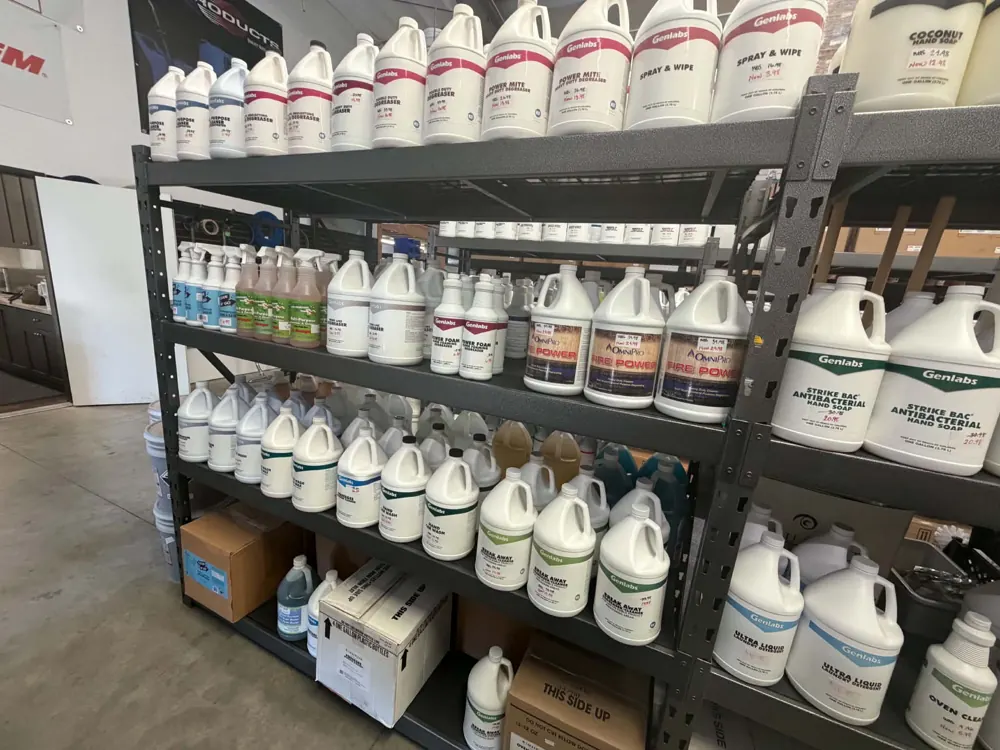
On the shelf for this work
 311612“Better Grip” Dish & Sink Brush$3.98 /each
 311510“Better Grip” Grout Brush$4.98 /each
 23031010″ Multi Surface Deck Scrub Brush Blue$11.98 /each
 23071010″ MULTI-SURFACE DECK BRUSH WITH SQUEEGEE$21.98 /each
 23101010″ MULTI-SURFACE DECK SCRUB BRUSH (GREEN)$15.98 /each
 23011010″ WHITE TAMPICO DECK SCRUB BRUSH$10.98 /each
 41041212″ Plastic Hand Held Dust Pan$4.98 /each
 901-003614″ Horse Hair Brush Floor Tool – With Front Cutout$48.66 /each
Paper and liners: buy the case, count the week
Paper is the heaviest, bulkiest and most predictable spend in a building, which is why it rewards buying by the case. Toilet tissue, roll towels, folded towels and trash liners all go by the case, and the janitorial aisle carries them from Tork and Kimberly-Clark paper programs and Royalty liners in the common sizes and mil thicknesses.
Match paper to dispenser before you match it to anything else. A roll towel that does not fit the dispenser on the wall gets stuffed into the wrong holder and jams on the first busy day. Tissue has the same problem with jumbo-roll and standard holders. Write down what is mounted in each restroom and keep that sheet where the order gets placed.
For liners, size is the usual mistake. A liner a size too small slides into the can and leaves the bag half-hanging; a liner a size too big wastes plastic on every change. Our can liner sizing guide shows how to measure the can and pick the dimensions and mil. Heavier work, such as a restaurant kitchen or warehouse floor, wants more mil than an office wastebasket does.
Soap and dispensers: pick the dispenser first
Hand soap comes in refills made for a specific dispenser. Foam, liquid, bulk fill and cartridge systems are not interchangeable, and a refill that does not fit the dispenser in your restroom is worth nothing. When a building changes soap, the dispensers usually need to change too, so make that one decision for the whole property instead of piece by piece.
Dispensers pay for themselves in waste. Controlled-dose units reduce the amount a person takes and the amount that ends up on the counter. Towel dispensers that feed one sheet at a time cut paper use. They also reduce the late-night phone call about the empty restroom, because a full cartridge lasts longer than a half-used bag.
The counter can help you map what is in a building and what it takes to keep it filled. Bring photos of the dispensers on the wall, or the model number off the side, and we will match refills to them.
A practical habit for contractors who take over a building mid-contract: walk every restroom on day one, photograph each dispenser, and write down what was in it. That sheet becomes your first order, and it keeps you from guessing what the previous crew left behind.
Disinfectants: quats, dwell time and the label
A disinfectant works when it stays wet on a surface for the dwell time written on its label. That number, often several minutes, is the one most often ignored, and it matters more than the brand. Spraying and wiping dry right away cleans the surface and may not disinfect it at all.
Quaternary ammonium products, or quats, are the common workhorse for restrooms, counters and general surfaces. They have limits: they should be used at the labeled dilution, never mixed with bleach or other chemicals, and applied to a surface that has already been cleaned of soil, since soil uses up the active ingredient. Gloves and eye protection belong in the closet with the jug.
Disinfecting and cleaning are separate steps, and the labels reflect that. A medical office, a school nurse’s office and a restaurant each have different expectations from their inspectors or customers. If your contract names a claim, such as a specific organism or a food-contact sanitizing step, check the product page and the SDS before you buy, and ask us if you cannot find it.
Glass, restrooms and the daily chemistry
Most of the daily work in a building comes down to a short list: glass cleaner, a bowl cleaner, a general degreaser, a restroom cleaner and a neutral floor product. The janitorial aisle has all of them in gallons and cases, and the reorder is the same every month, which makes them the easiest items to put on a standing order.
Bowl cleaners are usually acidic. Bleach-based products and acids must never be combined, and many restroom emergencies start with a custodian mixing leftovers from two bottles into one bucket. Keep products in their original or properly labeled containers, and keep the dilution chart on the closet door.
For glass, the tool matters as much as the chemical. A squeegee and a lint-free cloth beat a paper towel and a spray bottle every time. Mops, buckets, brooms, gloves and the rest of the closet kit are all in the same aisle, so a first order for a new contract can be one trip.
Gloves are the line item people underestimate. A crew that goes through them by the box should size them to the people wearing them, since a glove that does not fit gets taken off at the worst moment. Stock a couple of sizes and keep the sticky notes on the shelf that say which is which.
Par levels, and why one vendor beats five
A par level is the amount of each item that should be on the shelf at the start of the week. Set it by watching actual use for a month, then add a cushion for your delivery interval. Anything that falls under par gets ordered. It is a boring system, and it is why well-run buildings never run out of toilet paper.
Consolidating vendors takes work out of the accounts payable pile and the receiving dock. One order, one delivery, one invoice and one phone number replace a week of calls. For a custodial contractor with six buildings, that means a single standing order can be split by site, and a supervisor can see what each building uses.
Our guide to janitorial closet par levels has a worksheet approach to setting the numbers. Accounts can carry a card on file and add authorized buyers, so a site supervisor can order without the owner on the phone, and a resale certificate removes sales tax where it applies.
Buildings in the Valley: schools, packing houses, medical offices and churches
Fresno’s building stock is mixed. School districts run dozens of campuses on the same summer calendar and burn through liners and towels all year. Medical offices along Shaw and Herndon need clean restrooms and documented disinfection. Churches have small crews and big weekends. Warehouses and packing houses in the industrial areas off Highway 99 deal with dust, forklift traffic and crews that go through gloves and paper fast during harvest.
Dust shapes the supply list. Harvest and fall field work put fine particles on every horizontal surface, so dust mops, microfiber and filters get used up faster than the catalog suggests. Summer heat shortens the life of anything stored in a hot van or an un-air-conditioned shed, so keep chemicals in the shade and rotate stock.
If you hold a contract for a packing house, a dairy office or a cold-storage warehouse, tell the counter what the building needs, whether that is food-safe sanitizers, heavy-mil liners or non-slip floor products, and we will build the order around it.
Restaurants along Blackstone, Shaw and Clovis Avenue add grease, floor drains and health inspections to the mix. Their lists lean on degreaser, food-contact sanitizer and a lot of liners, and the weekly rhythm is steady all year, which makes them an easy standing order.
Delivery cadence for a building that cannot run out
The route truck is built for repeat orders. Fresno, Clovis, Sanger and Fowler get a drop every weekday; Selma, Kingsburg, Dinuba, Reedley, Visalia, Tulare and Hanford on Tuesday and Thursday; Madera on Wednesday. Order by 11:00 AM for the next route day, and orders over $150 on the route are delivered free.
A good cadence is weekly for a school or large office, every two weeks for a church or small building, and the day before a big event for anything else. Pick your route day, set the par levels to cover it, and the closet takes care of itself.
If a delivery lands on a day nobody is in the building, tell us where the driver should leave it, and who to call. A pallet of paper sitting out in the August sun is a bad start to the week, so plan the drop around when the door is open.
Outside the route towns, orders ship UPS Ground the same day when placed by 2 PM, free over $300. Cases of paper add up fast, so over 150 pounds goes LTL on a pallet. Chemicals ship ground only and a few cannot ship at all.
Commercial cleaning and janitorial supplies by town
Questions we get at the counter
How do I pick the right trash liner size?
Measure the can’s circumference and height, then match the liner’s width and length to those numbers with a few inches to fold over the rim. Add the mil by use: thin for office paper, heavier for kitchens, warehouses and anything with sharp edges. Our can liner sizing guide has the formula. Bring the can dimensions to the counter and we will pick it with you.
What does dwell time mean on a disinfectant label?
Dwell time is how long the surface must stay visibly wet with the product for it to disinfect. It is printed on the label, and it can be several minutes. Wiping the surface dry sooner cleans it but may not meet the claim. Clean away visible soil first, because soil reduces the product’s effect, and always follow the directions on the label.
Can I mix cleaning chemicals to save time?
No. Never combine products unless the label says it is safe, and never mix bleach with acids or ammonia-based products, since doing so can release toxic gas. Use each product at its labeled dilution in a clearly labeled container, wear the PPE the label calls for, and keep the SDS binder where your crew can reach it.
Why would I consolidate my janitorial purchasing with one supplier?
One supplier means one order, one delivery day and one invoice, instead of coordinating several vendors. It also makes par levels easier to track, because all your use is in one record. For a contractor with several buildings, orders can be split by site while the paperwork stays simple. It is mostly a time and consistency benefit.
How often should janitorial supplies be delivered?
It depends on use and storage. Schools and large offices usually do well with weekly drops, smaller buildings and churches every two weeks, and seasonal operations like packing houses may swing with harvest. Set par levels so the closet covers the gap between deliveries, with a cushion for a bad week. We can adjust as your numbers settle.
Does MarCo deliver janitorial supplies outside Fresno?
Our own truck serves twelve towns on fixed route days: Fresno, Clovis, Sanger and Fowler every weekday, Selma, Kingsburg, Dinuba, Reedley, Visalia, Tulare and Hanford on Tuesday and Thursday, and Madera on Wednesday. Anywhere else ships UPS Ground, same day if ordered by 2 PM. Ask about a route stop if you are close to the line.
Who buys this from us
- custodial contractors
- property managers
- school and district facilities
- medical and dental offices
- churches
- restaurants
- warehouses and packing houses